
Editor’s note: This article was originally published in March 2025 and has been updated to reflect current data on farm bankruptcies, right-to-repair legislation, and federal policy developments through May 2026.
If there is one group of workers you would expect to have full support and freedom to do their jobs, it would be America’s farmers. The men and women who work from before sunup to after sundown, sometimes seven days a week, to feed the country.
The reality is more complicated. Farmers face pricing pressure from corporate consolidation, legal restrictions on repairing their own equipment, and an economic downturn that has pushed bankruptcies to levels not seen in years. At the same time, a growing movement across both political parties is pushing back, asserting farmers’ rights to fair markets, functional equipment, and a viable livelihood.
Historical Context
Farmers’ fights for fairness are as old as American agriculture itself. In the late 19th century, movements like the Grange and the Populist Party challenged railroad monopolies and pushed for fair crop prices, leading to early antitrust reforms. During the Great Depression, New Deal policies introduced price supports and supply management programs to stabilize farm income.
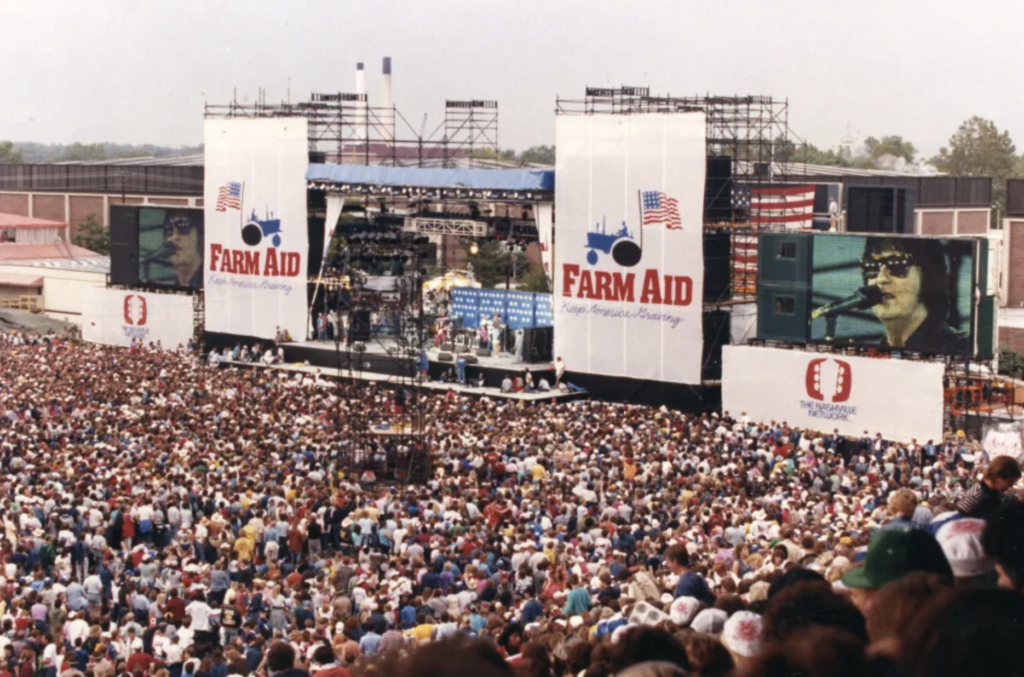
The 1980s farm crisis remains the most recent benchmark. Land values collapsed, interest rates soared, and thousands of families lost their farms. In 1979, nearly 3,000 farmers drove their tractors to Washington, D.C., demanding relief from low prices and debt. That event became known as the Tractorcade. Farm Aid, launched in 1985 by Willie Nelson, John Mellencamp, and Neil Young, rallied national attention and funds for struggling farm families.
That crisis passed. The current moment is drawing comparisons to it.
The Economic Pressure Right Now
The American Farm Bureau Federation released its 2025 bankruptcy report in February 2026. Chapter 12 farm bankruptcies, the form of debt restructuring designed specifically for family farm businesses, surged 46% in 2025 to 315 filings, the third consecutive annual increase. The Midwest region saw a 70% increase in filings. The Southeast was up 69%. Arkansas led all states with 33 filings, more than double 2024 and the highest in the state this century.
Total U.S. farm debt is projected to reach a record $624.7 billion in 2026, according to USDA estimates. Net farm income has declined for four consecutive years. The AFBF has characterized the situation as a generational downturn, with farmers increasingly relying on debt to cover operating expenses rather than capital investment.
15,000 small farms closed or consolidated in 2025, according to USDA data compiled by the American Farm Bureau Federation. That brings the total number of U.S. farm operations to approximately 1.9 million, down from 2 million in 2018. Most of the lost acreage is still being farmed, absorbed into larger operations, but the human and community cost of that consolidation is real.
For context: these bankruptcy numbers remain below the highs of the 2010s, when Chapter 12 filings exceeded 500 in some years. Economists are careful to note that today’s situation differs from the 1980s crisis in important ways. Farmland values have not collapsed and debt-to-asset ratios, while rising, remain below the dangerous levels of that era. But the direction of travel is concerning, and the pressure is real for farmers on the ground.
The economic squeeze has multiple causes. Crop prices, particularly corn and soybeans, have been weak. Input costs including fertilizer and machinery remain elevated. Tariffs have created uncertainty in export markets. And farmers who entered the business during the high-price years of 2021 and 2022 are now absorbing losses with thinner margins than they budgeted for.
Market Consolidation
Beyond input costs and commodity prices, farmers operate in a market where they often have little control over what they are paid. According to the American Farm Bureau Federation’s March 2026 Market Intel report, farmers and ranchers received a combined 5.8 cents of every food dollar after accounting for production expenses in 2024. Crop farmers received roughly 2.5 cents of that. The remaining 94 cents covers processing, packaging, transportation, wholesaling, retail, and food service costs, nearly all of which flow to entities other than the farmers who grew the food.
In beef processing, four companies control roughly 80 to 85% of fed cattle slaughter in the United States: Tyson Foods, JBS, Cargill, and National Beef. Concentration is similar in pork and poultry. With few buyers competing for livestock, farmers often have limited leverage to negotiate better terms. The Packers and Stockyards Act of 1921 was designed to prevent exactly this kind of abuse. Decades of lax enforcement allowed consolidation to advance.
Reforming competition policy in agriculture has bipartisan support in theory. In practice, comprehensive legislative change has been slow. Proposals to lower the legal bar for farmers bringing suits under the Packers and Stockyards Act, ban the tournament payment system in poultry contracts, and require more transparent pricing in cattle markets have been debated in Congress without passing. The pressure to act is growing as the economic data gets harder to ignore.
Right to Repair in 2026
The right-to-repair fight is the most active policy front in agriculture right now, and it has produced real results in the past year.
The core issue: modern farm equipment is controlled by software. For years, manufacturers including John Deere restricted access to diagnostic tools and repair software, effectively requiring farmers to use authorized dealers for any repair involving the machine’s electronic systems. During harvest or planting, a broken sensor or software glitch can idle a combine and threaten an entire season’s yield. Farmers have long compared the situation to owning a car you are not allowed to open the hood on.
February 2026 EPA guidance. On February 2, 2026, the EPA issued guidance clarifying that the Clean Air Act supports, rather than restricts, farmers’ ability to repair their own equipment. The guidance makes clear that manufacturers can no longer use the Clean Air Act as justification for limiting access to repair tools or software. EPA Administrator Lee Zeldin stated that manufacturers had “wrongly used the Clean Air Act to monopolize the repair markets, hurting our farmers.” The guidance also addressed diesel emissions override restrictions, clarifying that temporary overrides for repair purposes are permitted under the law.
This is a significant development. It removes a major legal argument that manufacturers had used to justify repair restrictions, and it came in direct response to a June 2025 request from John Deere asking EPA to clarify the matter.
Federal legislation. The Freedom for Agricultural Repair and Maintenance Act (the FARM Act, HR 5857) was introduced in the 119th Congress. It would require manufacturers to provide owners and independent repair providers with the tools, software, and documentation needed to diagnose and repair farm equipment. The bill is pending in the House.
State-level progress. Colorado passed the first state agricultural right-to-repair law in 2023. Washington state followed in May 2025. California, Minnesota, Connecticut, and Oregon have all passed comprehensive right-to-repair regulations covering various categories of products. As of spring 2026, the movement has explicit bipartisan momentum at both the state and federal levels. CNBC reported in April 2026 that right-to-repair has done something rare: brought Republicans and Democrats together.
The voluntary agreement. In early 2023, John Deere, Case IH, Kubota, AGCO, CLAAS, and CNH Industrial signed memoranda of understanding with the American Farm Bureau Federation, pledging to voluntarily expand access to repair tools. Farm Bureau agreed not to lobby for new legislation in exchange. The agreement provided some initial access to diagnostic tools and manuals.
Farmer advocates remain cautious about the voluntary approach. The agreements are not legally binding, and reports from the field suggest the tools provided to customers are more limited than what dealer technicians have access to. Most advocates argue that enforceable legislation, not voluntary pledges, is the only reliable path to full repair rights. The EPA guidance and the FARM Act represent movement in that direction.
Grassroots Advocacy
Farmers, fitting with their inspiring work ethic, have not waited for Washington to act. The National Farmers Union, founded in 1902, continues to advocate for fair market policies through its Fairness for Farmers campaign. Farm Action and the National Family Farm Coalition organize farmers and consumers around monopoly power, farm income parity, and seed patent reform.
Farm Aid, now more than 40 years removed from its first concert in 1985, continues to raise funds for family farmers and draw attention to the structural issues facing American agriculture. Direct sales through farmers’ markets, community-supported agriculture programs, and farm-to-school initiatives allow some producers to capture a larger share of the consumer dollar and reduce dependence on corporate middlemen. These approaches do not solve the structural problems, but they provide real income support for the farms that can access them.
Outside of the U.S., European farmers who face similar pressures took a different approach. Thousands of tractors descended on Brussels in 2024 and 2025, dumping manure outside the EU Parliament and forcing the reversal of several major agricultural policies. American farm advocacy has historically worked through organizations, courts, and legislation rather than the streets, though the economic pressure driving those European protests is not unfamiliar here.
Farmers are also increasingly using social media and video platforms to tell their own stories directly, bypassing agricultural media and reaching consumers who otherwise have no visibility into how food is produced and what the business of farming looks like on the ground.
The Road Ahead
The economic data going into 2026 is, unfortunately, not too encouraging. Farm debt is at a record high, bankruptcies are climbing, and input costs are elevated by tariff uncertainty and global supply disruptions. The USDA projects net farm income will likely continue declining in 2026, with government payments accounting for nearly 29% of bottom-line farm income support, meaning market-based returns alone are not covering costs for many operations.
At the same time, there are some policy wins to be found. The EPA’s right-to-repair guidance is legally meaningful. State-level legislation is accumulating. The Farm Bill that passed the House in April 2026 includes provisions expanding access to credit and extending the Conservation Reserve Program, both of which matter directly to small farm operations.
The tension between genuine reform and slow institutional change has defined agriculture policy for generations. Farmers who have made it through previous downturns did so through adaptation, organization, and persistence, not by waiting for the problem to resolve itself.
Despite the debt loads, the bankruptcy filings, the consolidation, and the policy fights, American farmers are still showing up, day after day. Still planting, still growing, still harvesting. Still feeding 330 million people who largely have no idea how hard that work is. The obstacles are real, and the system is imperfect, but so is the determination of the men and women working through it. That has been true through every farm crisis in American history, and it is true now.
This article contains no affiliate links. It is provided as a news and information resource for the Working Acre community.